



Introduction
Walk into any supplement store in India or scroll past a fitness influencer's feed, and someone will pitch creatine HCL as the upgraded version of monohydrate. Smaller dose. No bloating. Better absorption. A premium price to match.
Here's the honest answer: creatine monohydrate remains the most well-researched sports nutrition supplement available, backed by over three decades of consistent evidence. Creatine HCL is more soluble and may genuinely suit a small group of people with digestive sensitivities. For most gym-goers, though, the higher price does not deliver a proportional advantage.
This article is for people already considering creatine who want to understand the real difference between these two forms — without sorting through marketing copy dressed up as science.
How Creatine Actually Works
Creatine is not a hormone, a stimulant, or a mystery compound. It's a molecule your body produces naturally from amino acids and also gets from dietary sources like meat and fish. It's stored in muscle tissue primarily as phosphocreatine.
During short, explosive efforts — a heavy deadlift, a sprint, the final reps of a hard set — your muscles need adenosine triphosphate (ATP) regenerated very quickly. Phosphocreatine donates a phosphate group to help rebuild ATP in real time, giving your muscles the fuel they need for that brief, high-intensity window.
Supplementing with creatine increases the amount of phosphocreatine stored in muscle tissue beyond what diet and natural production alone can achieve. Both monohydrate and HCL aim to accomplish exactly this. The meaningful question is which form does it more effectively, more comfortably, and more economically.
Creatine Monohydrate: What Three Decades of Research Shows
Creatine monohydrate is, by a significant margin, the most studied supplement in sports nutrition history. Hundreds of peer-reviewed trials — conducted across age groups, fitness levels, and demographics — consistently find it supports strength gains, increased lean muscle, improved high-intensity exercise output, and faster recovery when used alongside resistance training.
In creatine monohydrate, each creatine molecule is bound to a single water molecule. This accounts for a small amount of additional weight per gram but does not affect how much active creatine is being delivered to muscle tissue.
Effective daily doses range from 3 to 5 grams. Most people do not need a loading phase. That protocol — a legacy approach from early research — was designed to saturate muscles faster but regularly causes digestive discomfort at those quantities. At 3 to 5 grams per day without loading, muscle creatine stores reach saturation in roughly three to four weeks, with considerably fewer side effects.
Micronized creatine monohydrate is ground to a much finer particle size than standard monohydrate. This improves its solubility in water noticeably, reduces the gritty texture that causes mixing complaints, and is significantly gentler on the stomach. It's a meaningfully better format than older-generation bulk monohydrate powders — and it addresses most of the digestive criticisms levelled at the compound.

Creatine HCL: What It Claims and What We Know
Creatine HCL (hydrochloride) is creatine bonded to a hydrochloride salt group. This molecular change increases water solubility dramatically — some estimates put it at 40 to 70 times more soluble than standard creatine monohydrate.
The case for HCL rests on three main claims:
- Lower effective dose: Because it dissolves more readily, 1 to 2 grams of HCL is marketed as equivalent to 3 to 5 grams of monohydrate
- Less bloating: Better solubility means less undissolved creatine causing gut irritation
- Faster absorption: Improved dissolution may translate to quicker uptake into the bloodstream
All three claims are at least partially plausible in theory. The problem is the evidence base. While monohydrate has hundreds of peer-reviewed trials supporting it, creatine HCL has very limited comparative research in humans. Few controlled head-to-head studies have directly measured muscle creatine saturation or performance outcomes between the two forms. The assumptions about HCL's superiority are largely extrapolated from its chemistry — not measured directly in well-powered trials.
HCL is also considerably more expensive per effective dose. In India, where most HCL products are imported, the per-serving cost is often two to three times that of quality domestic monohydrate.
Monohydrate vs HCL: Head-to-Head
| Feature | Creatine Monohydrate | Creatine HCL |
|---|---|---|
| Research depth | Extensive (30+ years of trials) | Limited (newer compound, thin evidence) |
| Effective daily dose | 3–5g | 1–2g |
| Water solubility | Moderate; high when micronized | Very high |
| Digestive tolerance | Good for most; better when micronized | Generally well tolerated |
| Evidence for muscle performance | Strong across multiple populations | Preliminary; no strong comparative data |
| Price per effective dose (India) | Lower | Significantly higher |
| Availability in India | Widely available | Limited; mostly imported |
| Vegetarian-friendly | Yes | Yes |
The Bloating Argument: Setting the Record Straight
Bloating is the main reason people abandon monohydrate and reach for HCL. The reputation is real — but the context behind it is often missing.
Most documented cases of creatine-related bloating trace back to the loading phase: taking 20 grams per day in multiple doses over five to seven days to saturate muscles rapidly. At those quantities, digestive discomfort is genuinely common. The gut struggles to handle that much undissolved creatine powder at once.
The issue is that most everyday gym-goers simply don't need to load. Taking 3 grams per day without any loading protocol achieves the same muscle saturation — just over a longer timeline — and with significantly fewer GI complaints. A lot of the negative monohydrate experiences shared online originate from improper loading doses, not from the compound itself.
There's also the particle size factor. Standard coarse-grade monohydrate mixes poorly, leaves residue in the gut, and causes the kind of grittiness and discomfort that fuels bad reviews. Micronized monohydrate dissolves cleanly and is considerably more comfortable to use. If your only experience with monohydrate was a poor-quality coarse powder taken at a loading dose, that's not a fair comparison point against HCL.
For those who still experience persistent discomfort at 3 grams of micronized monohydrate without any loading phase, creatine HCL is worth trialling. This is a real subset of users. It's just not the majority.
Why Vegetarian Gym-Goers in India Have More to Gain from Creatine
This deserves specific attention, because the Indian dietary context matters here more than most supplement discussions acknowledge.
Creatine in the diet comes almost entirely from animal sources: red meat, fish, and poultry. Indians who follow vegetarian or predominantly plant-based diets — a significant proportion of the population — typically have lower baseline muscle creatine stores than omnivores. Research consistently shows that vegetarians tend to see a more noticeable response to creatine supplementation in terms of strength and lean mass gains, precisely because they're starting from a lower creatine baseline.
ICMR-NIN data indicates that vegetarian diets across Indian populations often fall short of several performance-relevant nutrients that are concentrated in animal foods. Creatine is one of them. For vegetarian athletes and gym-goers — whether training at a commercial gym in Hyderabad, doing home workouts in Lucknow, or playing a competitive sport — monohydrate offers a well-validated, affordable route to addressing that gap.
Given the price differential between monohydrate and HCL in India, the practical case for monohydrate is especially strong.
Which Form Is Right for You?
The decision is cleaner than the marketing makes it appear.
Choose micronized creatine monohydrate if:
- You want the most evidence-backed option available
- You're new to creatine supplementation
- You're on a vegetarian or plant-heavy diet
- You're budget-conscious and want genuine value
- You've never had significant digestive issues with low-dose creatine
Consider creatine HCL if:
- You've tried micronized monohydrate at 3 grams per day — with no loading phase — and still experience persistent GI discomfort
- You're working in contexts where minimal powder volume genuinely matters
- Price is not a constraint and you want to explore your options methodically
If you're already on monohydrate and it's working, there is no meaningful evidence that switching to HCL will improve your results.
A few practical points worth keeping:
- Take creatine every day, including rest days
- Timing is flexible — post-workout or with a meal both work fine
- Stay well hydrated; creatine draws water into muscle cells, and hydration supports that process
- Expect 3 to 4 weeks to feel a difference at 3g per day without loading
- If you've been sedentary or training inconsistently, creatine alone won't override that
Frequently Asked Questions
Q: Is creatine HCL better than monohydrate for strength and muscle gains?
A: Not based on the available evidence. The bulk of research demonstrating creatine's benefits for strength and muscle used monohydrate as the test compound. HCL has not been directly compared in enough controlled trials to claim a meaningful performance advantage. The marketing language around HCL tends to outpace the research supporting it.
Q: Will creatine monohydrate cause kidney damage?
A: This concern is widespread but not supported by research in healthy individuals. Long-term studies at doses of 3 to 5 grams per day have not found links to kidney damage in healthy users. Anyone with a pre-existing kidney condition should consult their doctor before supplementing with creatine in any form.
Q: Do I need a loading phase with creatine monohydrate?
A: No. A loading phase (20g per day for 5 to 7 days) saturates muscles faster but is not necessary. A consistent 3g daily dose reaches the same saturation in about three to four weeks — and avoids most of the digestive complaints associated with creatine. Most people are better off skipping the loading phase entirely.
Q: Can women take creatine monohydrate?
A: Yes. Creatine is a cellular energy compound, not a hormone or steroid. Research indicates women respond to creatine supplementation with similar improvements in strength and exercise capacity. It does not cause masculinisation, excessive bulk, or hormonal changes. It's simply undermarketed to female gym-goers compared to male audiences.
Q: How much water should I drink while taking creatine?
A: There's no fixed prescription, but staying well hydrated is genuinely important. Creatine pulls water into muscle cells as part of its mechanism. If your total water intake is already low — especially relevant during Indian summers or monsoon humidity when thirst cues shift — you may notice increased thirst. Aiming for 2.5 to 3 litres per day is a reasonable general starting point.
Q: Does creatine HCL have fewer side effects than monohydrate overall?
A: For most people, side effects with either form are minimal or absent at appropriate doses. HCL may cause fewer digestive issues for those specifically sensitive to monohydrate — but in most cases, those digestive issues are a product of loading protocols and coarse particle sizes rather than an inherent flaw in the monohydrate form itself.
Ready to Start with the Form That Has the Research Behind It?
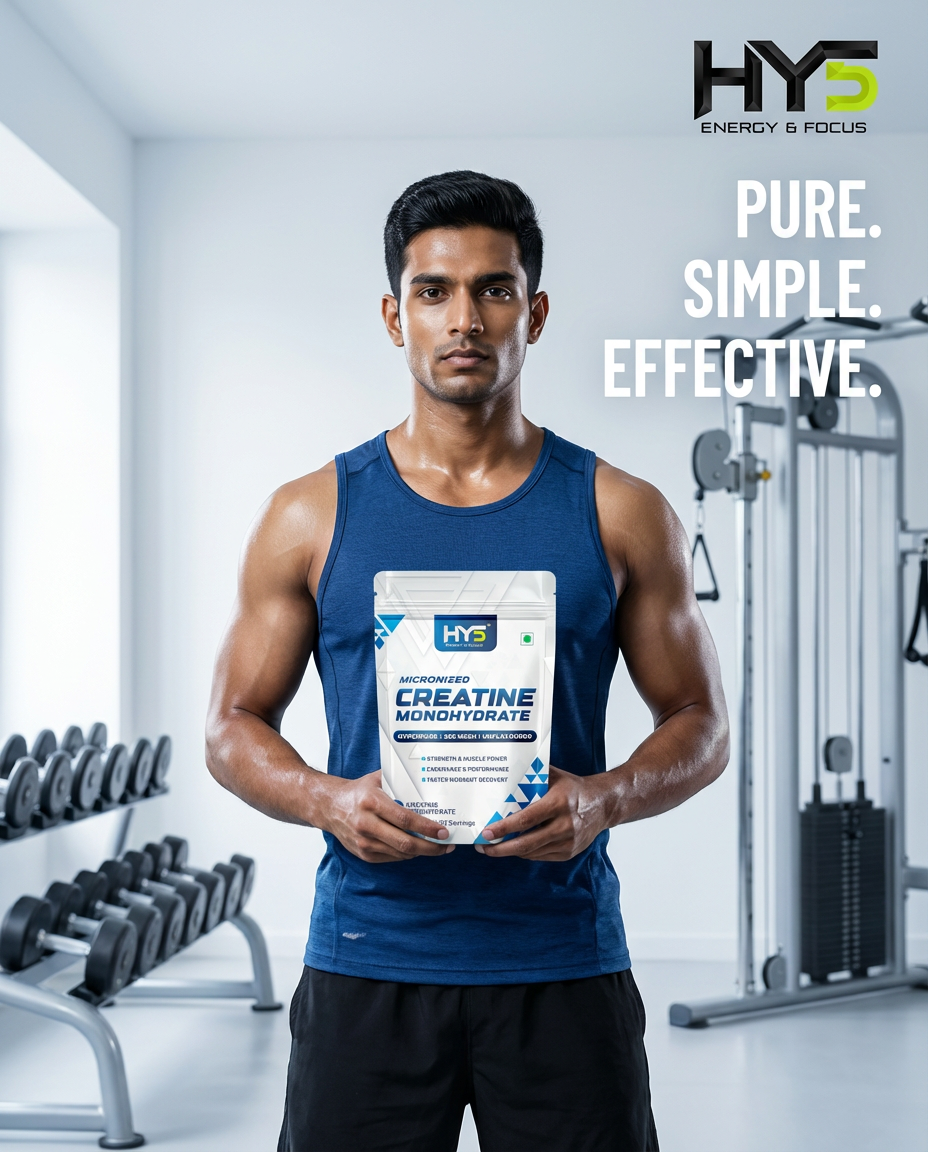
As a brand formulated under FSSAI-licensed manufacturing with a focus on evidence-backed ingredients, NutriPeak's HY5 Creatine Monohydrate uses a 200-mesh micronized form for clean mixability, minimal digestive load, and reliable absorption at 3g per serving — no loading required, no unnecessary fillers. It's designed for gym-goers who want effective supplementation without complexity. Available at ₹279 for 100g (33 servings).
If you want to explore a performance stack, HY5 Creatine + Taurine combines creatine monohydrate with 500mg of taurine to further support cellular hydration and sustained workout intensity, at ₹499 for 100g.
Disclaimer: This article is for informational purposes only and is not intended to diagnose, treat, cure, or prevent any disease. Always consult a qualified healthcare professional before making changes to your diet, supplement routine, or wellness plan.
