






Creatine for Beginners: The Complete Indian Guide (2026)
What Creatine Actually Is (And Why Everyone Is Talking About It)
Creatine is not a steroid. It is not a protein powder. It is one of the most studied performance supplements in sports science, and it works in a way that is straightforward enough to explain in two sentences.
Your muscles use a molecule called ATP for energy during short, intense efforts — a heavy squat, a sprint, a fast set of push-ups. Creatine helps your body regenerate ATP faster, which means you can push harder before fatigue sets in.
That is it. No magic. No shortcuts. Just a well-understood mechanism that has been replicated across hundreds of studies over three decades.
This guide is for anyone in India who is starting a gym routine, getting back into training, or has heard the word creatine enough times to finally want to understand it properly.
Who Actually Benefits From Creatine
Creatine is most useful for people doing activities that involve short bursts of intense effort. Think resistance training, sprinting, HIIT, football, badminton, and similar sports that demand explosive output.
If you are doing one of these, creatine is likely relevant to you:
- You have started lifting weights and want to progress faster
- You play a sport that involves sprints, jumps, or rapid direction changes
- You are a student-athlete trying to get more out of limited training time
- You are returning to training after a break and want to rebuild strength efficiently
- You are vegetarian or vegan — more on why this matters shortly
Creatine is less likely to produce noticeable results if your primary activity is long, steady-state cardio, such as marathon training or slow-paced cycling. It is not the right tool for every context, and knowing that upfront saves confusion.
The India-Specific Context: Why Vegetarians May Respond More
This is a detail that is genuinely relevant for a large portion of Indian gym-goers.
Creatine is found naturally in meat and fish. People who eat chicken, mutton, or seafood regularly already have a baseline level of creatine stored in their muscles. Vegetarians and vegans, whose diets include no direct dietary creatine sources, typically start with lower muscle creatine stores.
Research suggests that individuals with lower baseline creatine levels tend to see a more pronounced response to supplementation. For the significant portion of India's population that eats vegetarian or primarily plant-based diets — including those who eat eggs but not meat — creatine supplementation may offer a particularly meaningful benefit.
Dal, roti, paneer, curd, and eggs do not provide creatine. If these are your primary protein sources, supplementing with creatine monohydrate is one of the more evidence-backed decisions you can make as a training beginner.
How Creatine Works in the Body
Your muscles store creatine as phosphocreatine. When you perform a short, explosive effort, phosphocreatine donates a phosphate group to ADP to rapidly produce ATP — the energy currency your muscles actually use.
Without supplementation, this phosphocreatine pool is limited. Once it is depleted, your muscles have to switch to slower energy systems, and your performance drops. That is why your fifth rep often feels significantly harder than your first.
Supplementing with creatine monohydrate increases the amount of phosphocreatine stored in your muscles. Over time, this translates to:

- More reps completed at the same weight
- Slightly less fatigue during high-intensity sets
- Faster recovery between sets
- Gradual improvement in strength and muscle volume over weeks of consistent training
One important clarification: creatine does not directly build muscle. What it does is allow you to train harder and recover slightly better, which creates the conditions for muscle growth. The training still has to happen.
Loading Phase: Necessary or Overhyped?
One of the most common debates among beginners is whether to do a loading phase.
What loading means: Taking a higher dose (typically 20g per day, split into 4 doses) for 5–7 days to saturate your muscles quickly, followed by a lower maintenance dose.
What skipping loading means: Starting directly at a lower daily dose and allowing muscle creatine levels to build gradually over 3–4 weeks.
Both approaches reach the same endpoint. Loading gets you there faster. Skipping loading gets you there more slowly but with fewer potential digestive issues along the way.
For most Indian beginners, skipping the loading phase entirely is the more practical recommendation. Starting with 3–5g per day consistently is easier to maintain, causes fewer stomach issues, and produces the same long-term results. The urgency that loading addresses is rarely relevant for someone who is just starting out.
If you are preparing for a competition or an important event and need saturated levels within a week, loading makes sense. For general fitness and body composition goals, it is unnecessary.
How to Take Creatine: A Practical Routine
The most important factor with creatine is consistency. Timing matters far less than most beginners are led to believe. Here is a simple approach:
- Take 3–5g per day, every day — including rest days
- Mix it into water, juice, a protein shake, or even your dal if you want (it has no taste)
- Take it at any time that fits your routine — pre-workout, post-workout, or with breakfast
- Stay well-hydrated. Creatine draws water into muscle cells, so your fluid intake matters more than usual
- Give it 3–4 weeks before expecting noticeable changes. Patience is part of the protocol
One useful note for Indian summers: the heat increases fluid losses through sweat. If you are training in April through June, pay extra attention to drinking enough water throughout the day, not just around your workout.
There is no need to cycle off creatine or take breaks. Continuous use is safe and appropriate for healthy adults.
Common Myths That Still Circulate in Indian Gyms
Some of these come up in almost every gym conversation in India. It is worth addressing them directly.
"Creatine damages the kidneys." This concern is understandable but is not supported by the evidence for healthy individuals at normal doses. Research on long-term creatine use in healthy adults has not shown adverse effects on kidney function. If you already have a pre-existing kidney condition, speak to your doctor before supplementing.
"It is a steroid." It is not. Creatine is a naturally occurring compound found in food and produced in the body. It has no hormonal activity.
"You will lose all your gains when you stop." What you may lose is some of the water stored in muscle tissue, which can make muscles look slightly less full. The actual strength and muscle built during the period of creatine use does not disappear.
"It causes hair loss." One small study from 2009 suggested a possible link between creatine and elevated DHT levels in rugby players. This has not been replicated convincingly in subsequent research. The current evidence does not establish a causal relationship between creatine supplementation and hair loss.
"You need to take it with sugar for it to work." This originated from older research suggesting insulin improves creatine uptake. Practically speaking, taking creatine with a meal achieves a similar effect. You do not need to add sugar or a high-glycaemic drink.
Choosing a Creatine Product: What to Actually Look For
The supplement market in India has grown quickly, and product quality varies significantly. When evaluating a creatine product, these are the factors that matter:
- Form: Creatine monohydrate is the gold standard. It has the most research behind it and is the most cost-effective. Other forms (creatine HCl, buffered creatine, ethyl ester) have not consistently outperformed monohydrate in peer-reviewed research.
- Particle size: Micronized creatine (200 mesh) mixes better in water and is gentler on the stomach. If you have had digestive issues with creatine before, a micronized version is worth trying.
- Additives: Look for unflavoured options with no unnecessary fillers, artificial dyes, or proprietary blends that obscure actual creatine content.
- Dose transparency: The label should clearly state the creatine monohydrate content per serving.
- FSSAI compliance: Any supplement sold legally in India must carry a valid FSSAI licence number.
Frequently Asked Questions
Q: Can women take creatine? Yes. Creatine is not a male-specific supplement. Research on female athletes and active women shows similar performance benefits. It does not cause masculinisation or hormonal changes. Women who strength train, play sports, or want to improve body composition can use creatine the same way men do.
Q: I am a college student who works out 3 times a week. Is creatine worth it for me? If you are doing resistance training or high-intensity exercise in those sessions, creatine can support your progress. Three sessions per week is enough frequency to make creatine supplementation meaningful. Consistency in training and diet will still matter more than any supplement, but creatine is one of the few additions that has a genuine evidence base for training beginners.
Q: Should I take creatine on rest days? Yes. Creatine works by keeping your muscle stores saturated, and that requires daily intake. Missing rest days regularly will slow down the saturation process. Taking it with your morning routine or breakfast is an easy way to build the habit.
Q: Can I take creatine with my protein shake? Yes, this is a common and convenient approach. Mixing creatine with a protein shake, water, or any meal does not reduce its effectiveness.
Q: Will creatine make me look bloated or puffy? Some people notice a slight increase in body weight (typically 0.5–1.5 kg) in the first 1–2 weeks. This is intracellular water — water drawn into muscle cells, not subcutaneous water retention. It is not the same as bloating. Most people find their physique looks fuller rather than puffy, and some do not notice any change at all.
Q: Is there a best time to take creatine? Timing is the least important variable in the creatine equation. Some research suggests post-workout timing may offer a marginal benefit, but the practical difference is small. Take it when it fits your routine and you are most likely to take it consistently.
Try HY5 Creatine Monohydrate
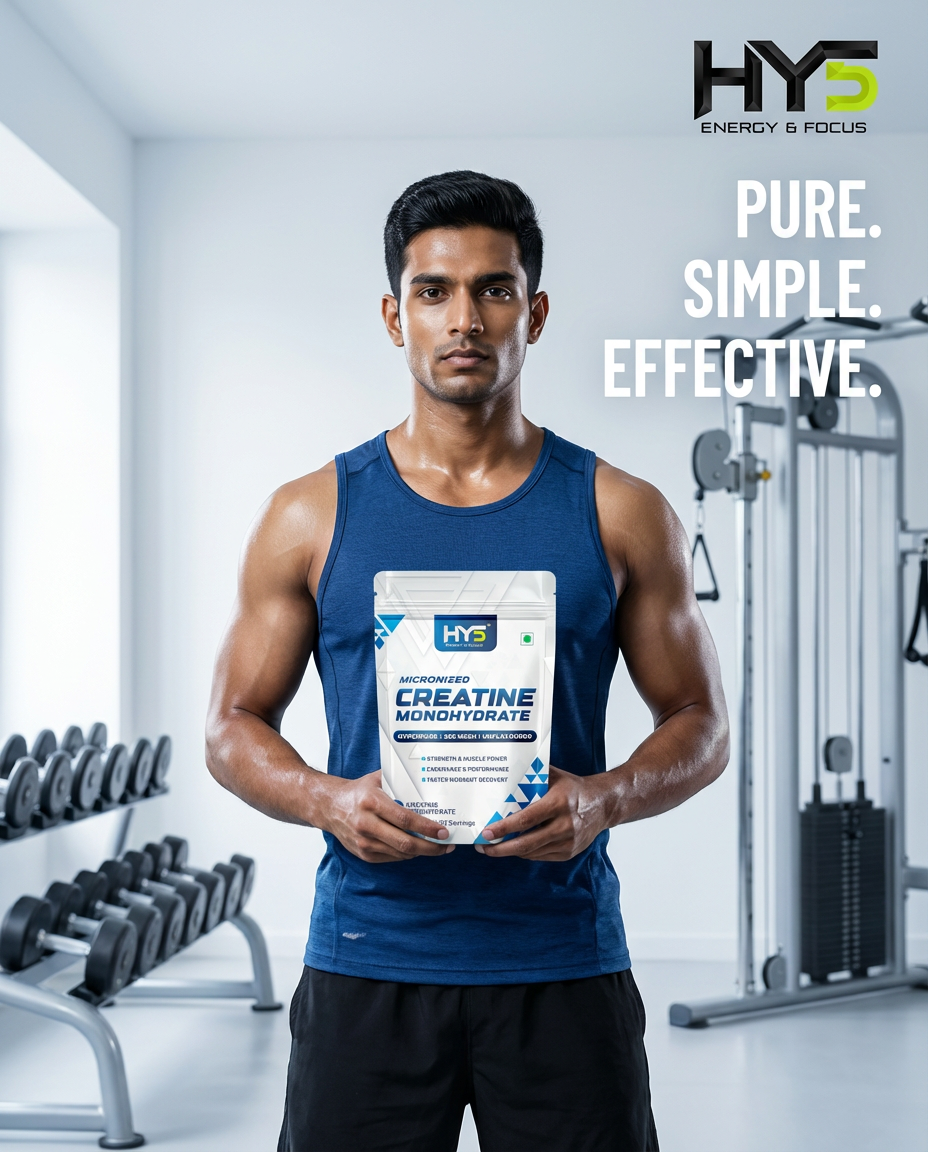
If you are ready to add creatine to your routine, HY5 Micronized Creatine Monohydrate provides 3g of ultra-fine, 200-mesh creatine per serving in an unflavoured format that mixes cleanly into water, shakes, or juice. For those who want an added performance edge, HY5 Creatine + Taurine combines creatine with taurine to support cellular hydration and extended training performance. Both are available at nutripeak.in.
Disclaimer: This article is for informational purposes only and is not intended to diagnose, treat, cure, or prevent any disease. Always consult a qualified healthcare professional before making changes to your diet, supplement routine, or wellness plan.
