




Walk into any supplement store in India right now, or scroll through any fitness brand's product page, and you'll find "clinically dosed" on at least half the labels. It sounds authoritative. It implies the formula was built from research, not guesswork. The problem: no regulatory body in India, or anywhere globally, has defined exactly what "clinically dosed" requires a product to prove before using the phrase.
This gap between expectation and reality matters. Consumers who understand the term are paying more for products that promise research-backed formulation. Many of those products don't deliver on that promise. Some do. Knowing the difference is simply a matter of understanding a few specific things about how supplement research works, and how to read a label against it.
This guide is for anyone who has seen this term and wondered whether it's meaningful or marketing noise.
The Real Definition, Without the Marketing Language
"Clinically dosed" has a defensible meaning even if it lacks a legal one. The term refers to a supplement containing each active ingredient at a quantity that matches the dose used in peer-reviewed clinical research to produce a measurable effect.
That's the whole definition. It doesn't mean the product has been clinically tested itself. It doesn't mean a doctor endorsed it. It means the amounts on the label correspond to what researchers actually gave study participants when they measured outcomes.
The distinction matters because an ingredient appearing on a label tells you nothing about its quantity. A product can list creatine, ashwagandha, and beta-alanine in its formula and contain each at a fraction of what any study used. The ingredient list looks impressive. The amounts do not match the research. That product is not clinically dosed, regardless of what the packaging says.
The credible interpretation of the term requires three things: ingredient transparency (amounts are disclosed), amounts that align with studied doses for that specific ingredient, and a formulation that does not bury key ingredients inside undisclosed proprietary blends.
Why the Dose Matters as Much as the Ingredient
Consider creatine. It is one of the most studied performance supplements in existence. Research examining its effects on muscular strength, power output, and training recovery has consistently used doses in the range of 3 to 5 grams per day. This dose range has been replicated across hundreds of studies over several decades. The effects observed in that research are specific to that dose.
A product containing 1 gram of creatine per serving in a larger "performance matrix" is not clinically dosed for creatine. The ingredient is present. The dose is not. At one gram daily, the phosphocreatine saturation that underlies creatine's established mechanisms simply doesn't occur at the rate research demonstrates.
This principle applies across most supplement categories. Every studied ingredient has a dose range at which its effects have been observed. Below that range, you are not recreating the conditions of the research. The ingredient name on the label remains the same. The outcomes you are likely to experience do not.

Nutritional science describes this using the concept of a threshold dose — the minimum quantity at which an active effect becomes likely based on the evidence. "Clinically dosed" means meeting that threshold. Sub-threshold amounts, however expertly the label is designed, do not qualify.
Label Dressing: The Practice That Makes This Problem Common
The industry term for including ingredients at sub-therapeutic amounts to create an impressive label is "fairy dusting" or "label dressing." It is widespread. It is also entirely legal.
The logic is commercial. Certain ingredients carry strong consumer recognition. Beta-alanine, citrulline, ashwagandha, curcumin, and others have developed reputations through research coverage and word-of-mouth in fitness communities. Including them on a label associates the product with that reputation, even at doses that will not produce the outcomes associated with the research.
A product can list fifteen ingredients and contain each at a fraction of the studied dose, keeping manufacturing costs low while delivering a label that looks scientifically sophisticated. Without knowing the studied dose for each ingredient and comparing it to what is disclosed on the label, there is no way to identify this from packaging alone.
This is not a fringe practice. FSSAI licensing in India requires ingredient disclosure on supplement labels, which is a meaningful protection. But disclosure of presence does not require disclosure of adequacy. A brand can comply with labeling requirements while still formulating well below studied thresholds.
Proprietary Blends and Why They Complicate the Picture
A proprietary blend is a combination of ingredients listed by a combined total weight rather than individual amounts. The label might say "Recovery Matrix — 4,500mg" and list five ingredients underneath, but the amount of any single ingredient within that 4,500mg is not disclosed.
This makes evaluating clinical dosing impossible from the outside. You cannot cross-reference an undisclosed number against a studied dose. You cannot determine whether any individual ingredient meets its threshold. The only certainty is the total blend weight, which tells you very little about the formulation quality of any component within it.
Some brands use proprietary blends to protect genuinely novel formulations from direct replication. Others use them precisely because disclosure would reveal sub-therapeutic dosing. As a buyer, the information required to distinguish between these two cases is simply not available from the label. That uncertainty is itself a signal.
For any supplement category where the clinical evidence is what you are paying for, a fully transparent label is the baseline standard. Each ingredient listed with its individual amount. No blends obscuring what you are actually consuming per serving.
How to Actually Check If a Supplement Is Clinically Dosed
This is a practical process, not an expert-level one. It takes a few minutes per product.
- Check for a full ingredient panel with individual amounts. If any ingredient is listed within a proprietary blend without its own weight disclosed, that ingredient cannot be evaluated for clinical dosing. Move on or accept that you cannot verify the claim.
- Identify the ingredient you care most about. For a creatine product, that is creatine. For a curcumin product, curcumin and piperine. Focus your evaluation on the primary active compound.
- Look up the studied dose for that ingredient. PubMed and Examine.com are the most accessible references. Search for the ingredient alongside terms like "clinical trial," "human study," or "effective dose." You are looking for the dose range used when researchers measured outcomes.
- Compare the label amount to the studied range. If the amount disclosed falls within the studied range, the product meets the basic standard. If it falls significantly below, the "clinically dosed" claim is at best aspirational.
- Check whether the product needs any co-ingredient for its key compounds to work. Curcumin without piperine at adequate amounts is a common example. The primary ingredient at the right dose is only part of the picture.
This process does not require a science background. It requires reading two numbers and comparing them.
The Honest Nuance: Even "Clinically Dosed" Has Limits
There is a point where the term gets genuinely complicated, and acknowledging it is more useful than pretending otherwise.
Clinical research does not always produce a single definitive dose. Studies use different populations, different durations, different outcome measures. A dose that produces one result in a sedentary population may behave differently in trained athletes. Individual variation in metabolism, gut health, and baseline nutrient status all affect how a supplement performs in a specific person, independent of whether the dose matches a research protocol.
"Clinically dosed" is a starting point for confidence in a formula, not a guarantee of a specific personal outcome. A product that meets the standard is formulating from a position of integrity. Whether it produces the outcome you are seeking depends on factors the research and the label cannot fully predict.
As a brand formulated under FSSAI-licensed manufacturing conditions, NutriPeak's position on this is direct: full ingredient transparency is non-negotiable in our formulations, and the amounts we use are based on what the published evidence supports, not on what creates an impressive-looking panel.
Frequently Asked Questions
Q: Is there a legal definition of "clinically dosed" in India?
A: No. FSSAI regulations govern labeling, safety, and permissible ingredient categories for supplements, but there is no specific regulatory definition that a product must meet before using the phrase "clinically dosed" on its packaging. The term is currently a marketing claim, not a certified standard. Evaluating it requires looking at the actual numbers on the label and comparing them to published research.
Q: How do I find the studied dose for a specific supplement ingredient?
A: Examine.com is the most accessible public resource for this. It aggregates human research on supplement ingredients and typically presents dose ranges with brief context. PubMed (accessible free at pubmed.ncbi.nlm.nih.gov) gives access to the original studies themselves. For most commonly used performance or wellness ingredients, a quick search with the ingredient name and "effective dose" or "clinical dose" will surface the relevant range within a few minutes.
Q: If a proprietary blend says it's 5,000mg total, can't I assume each ingredient is adequately dosed?
A: Not reliably. A 5,000mg blend containing ten ingredients could theoretically allocate most of its weight to the cheapest filler, with the remaining expensive actives present at minimal amounts. The total weight of a blend tells you almost nothing about the adequacy of any individual component. Only a fully transparent label with individual amounts allows you to evaluate dosing.
Q: Do all good supplements need to be "clinically dosed" in the strict sense?
A: The standard matters most for ingredients where the evidence base is specific to a studied dose range — creatine, beta-alanine, citrulline, curcumin with piperine, and similar well-researched compounds. For ingredients with less established dose-response research, or ingredients used in traditional formulations with a longer history than clinical trials, the calculus is different. The principle is most useful when the research exists and the claimed dose can be compared against it.
Q: Can a supplement be too highly dosed?
A: Yes. More is not automatically better, and for certain ingredients it can create concerns. Fat-soluble vitamins like D3 and A accumulate in the body and excess intake carries real risks over time. Even water-soluble compounds and performance ingredients have sensible upper limits. A good formulation targets the effective range established by research, not the maximum the label can claim.
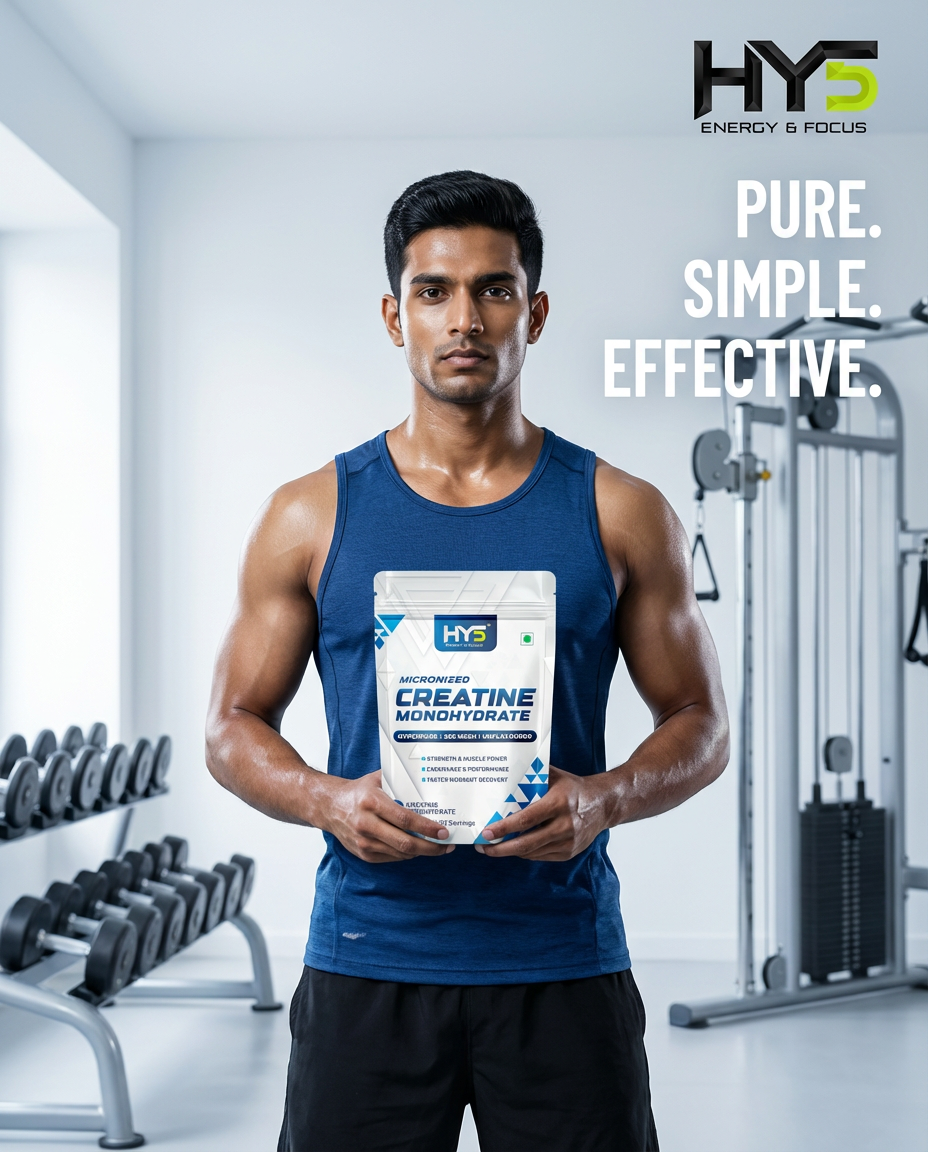
If you want a straightforward example of what label transparency looks like in practice: HY5 Creatine Monohydrate provides 3g of micronized creatine monohydrate per serving, clearly disclosed, with no blend obscuring the amount. That single number can be directly compared against the research consensus. NutriPeak Curcumin 95% + Piperine provides 500mg curcumin standardised to 95% curcuminoids alongside 10mg piperine, both individually listed. No blend. No guessing. These are not the only formulations worth considering, but they are examples of what a transparent label actually looks like in a real product.
Disclaimer: This article is for informational purposes only and is not intended to diagnose, treat, cure, or prevent any disease. Always consult a qualified healthcare professional before making changes to your diet, supplement routine, or wellness plan.
